





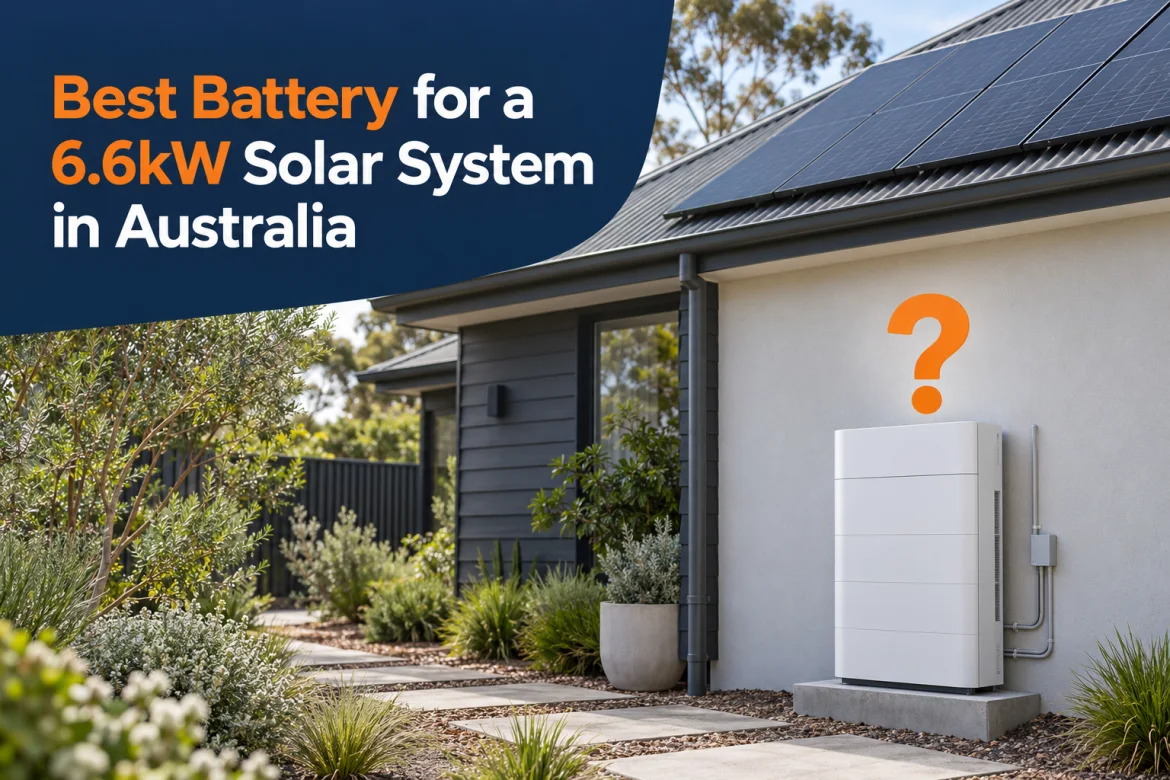
A battery around 10kWh to 13.5kWh of usable capacity is a useful starting point to assess for a 6.6kW solar system. The right size depends on your evening electricity use, surplus solar generation, inverter compatibility and backup needs. A larger battery is not automatically better value.
If you are comparing options for November or December 2026, installation timing also matters. The federal battery rebate is scheduled to reduce from 1 January 2027, with another reduction from 1 July 2027. This guide explains how to choose a battery and compare the discount across those dates, without assuming every home will achieve the same savings.
What size battery suits a 6.6kW solar system
Solar capacity is measured in kilowatts (kW), while battery storage is measured in kilowatt-hours (kWh). A 6.6kW solar array does not need a 6.6kWh battery: the two ratings describe different things. Usable battery capacity tells you how much stored energy can be discharged, before allowing for system losses and any reserve you keep for outages.
Use these ranges as a starting point for a household assessment, rather than a fixed sizing rule.
| Usable storage | When to consider it |
|---|---|
| 8–10kWh | Lower evening demand and a focus on storing surplus solar for later use. |
| 10–13.5kWh | Evening and overnight demand that can regularly use this storage, with enough surplus solar to recharge it. |
| 14–16kWh or more | Higher demand or a larger backup reserve, supported by a charging and financial assessment. |
Ask your installer to review interval meter data and solar monitoring across different seasons. Total solar production is not the same as surplus: appliances running during the day use electricity before it becomes available to charge the battery. Roof orientation, shading, weather and inverter limits also affect daily charging.
For example, a home exporting about 12kWh during the day and buying about 9kWh after sunset could assess a battery near 10kWh usable capacity. This is a sizing illustration, not an output prediction. Charging losses, cloudy periods and a backup reserve may change the result.
Can a 6.6kW solar system charge a 28kWh battery
It can charge a compatible larger battery, but it may not fill it from surplus solar every day. If the house uses much of its solar production during daylight hours, a 28kWh battery may have unused capacity for long periods.
A larger system may still suit a planned solar expansion, time-of-use charging strategy or substantial backup requirement. Grid charging can be useful when the tariff difference covers energy losses and battery wear. Ask for modelling that separates solar charging from grid charging; do not size the battery solely to maximise the rebate. Our battery size comparison sets out the same trade-off across other system sizes.
Federal battery rebate changes from January 2027
The Cheaper Home Batteries Program provides support through small-scale technology certificates, or STCs. Homeowners commonly assign their STC rights to an agent for a discount on the installation price. The dollar value depends on the number of certificates and the value offered for them; it is not a fixed cash amount for every household.
| Installation period | Battery STC factor |
|---|---|
| 1 May–31 December 2026 | 6.8 |
| 1 January–30 June 2027 | 5.7 |
| 1 July–31 December 2027 | 5.2 |
These are published scheduled reductions, not just a possible January change. The factor falls by about 16.2% from late 2026 to the first half of 2027, before rounding. This is a change in certificate entitlement, not a 16.2% increase in the full system price. Hardware prices, installation costs and STC values may also change.
How battery size affects the calculation
The capacity tiers introduced on 1 May 2026 apply the relevant period’s factor at 100% for the first 14kWh of usable capacity, 60% for the portion above 14kWh up to 28kWh, and 15% for the portion above 28kWh up to 50kWh. Capacity above 50kWh does not earn additional battery STCs.
A battery of 14kWh or less avoids the reduced capacity tiers, but it is still affected by the January and July factor reductions. Being within the first tier does not protect a system from the change in date-based entitlement.
Illustrative rebate comparison for 2026 and 2027
The table uses an assumed value of $40 per STC, solely to show the effect of the scheduled changes. Certificate counts are rounded down to whole STCs. These figures are not quotes, guaranteed rebates or net discounts after agent fees. Actual offers may use a lower STC value.
| Usable capacity | May–Dec 2026 | Jan–Jun 2027 | Jul–Dec 2027 | January reduction |
|---|---|---|---|---|
| 10kWh | 68 STCs ($2,720) | 57 STCs ($2,280) | 52 STCs ($2,080) | $440 |
| 12.8kWh | 87 STCs ($3,480) | 72 STCs ($2,880) | 66 STCs ($2,640) | $600 |
| 13.5kWh | 91 STCs ($3,640) | 76 STCs ($3,040) | 70 STCs ($2,800) | $600 |
| 14kWh | 95 STCs ($3,800) | 79 STCs ($3,160) | 72 STCs ($2,880) | $640 |
| 28kWh | 152 STCs ($6,080) | 127 STCs ($5,080) | 116 STCs ($4,640) | $1,000 |
For example, a 13.5kWh usable battery creates 91 STCs under the late-2026 factor and 76 under the January–June 2027 factor. At the assumed $40 value, that is $600 less support. A 14kWh usable battery changes from 95 to 79 STCs, a $640 difference on the same assumption. The exact usable capacity matters: a product advertised as “14kWh” may have a different usable rating.
Does booking in December lock in the 2026 rebate
No. Signing a quote or paying a deposit in 2026 does not by itself secure the 2026 factor. The applicable period depends on installation and certification. Government guidance treats the battery as installed from the date the certificate of electrical compliance, or its state or territory equivalent, is issued.
Before accepting a quote, confirm the expected compliant completion date, which factor the quote assumes and how the price will change if completion moves into 2027. Allow time for approvals, product availability and safe installation. The rebate continues in 2027 at the scheduled lower factors; it does not end on 31 December 2026.
Battery options to compare for a 6.6kW system
There is no universal best brand. Compare the exact Australian model and configuration against your existing inverter, required output power, usable storage and installed price. The examples below are a shortlist for comparison, not a ranking or a guarantee of availability through Smart House Solar. Our best solar batteries in Australia 2026 buyer's guide covers these products in more detail.
| Battery option | What to assess |
|---|---|
| Tesla Powerwall 3 | 13.5kWh usable storage with an integrated solar inverter. Check the proposed connection and backup design for your home. |
| Sungrow SBR | The published range spans 6.4–25.6kWh. Compare configurations such as 9.6kWh and 12.8kWh with a compatible inverter. |
| Sigenergy SigenStor | If EV charging is part of your plan, ask which charging modules and vehicle capabilities are included in the proposed system. |
| AlphaESS | Compare the exact residential system, usable capacity, inverter arrangement and Australian warranty terms. |
| BYD Battery-Box | Check the specific battery configuration against the manufacturer’s current compatible inverter list. |
Lithium iron phosphate (LFP) is one chemistry to compare, but chemistry alone does not establish reliability or suitability. Request the exact datasheet and written warranty. Check capacity retention, throughput limits, temperature conditions, labour coverage and who provides local support. Avoid assuming all brands offer identical ten-year protection.
Can you add a battery to existing 6.6kW solar
Often, yes. A compatible hybrid inverter may allow a battery connection, while another system may need an AC-coupled battery or an inverter upgrade. An installer must assess the existing equipment, electrical condition and network requirements before confirming the design. We cover this in detail in our guide to adding a battery to an existing solar system.
For federal eligibility, check that the proposed system meets the current product and installation rules. These include an eligible new battery connected to new or existing solar, the applicable CEC product approvals, and installation by an SAA-accredited installer with battery endorsement. Eligible nominal battery capacity is 5–100kWh, with support limited to the first 50kWh of usable capacity. See who is eligible for the federal battery rebate for the full conditions.
Grid-connected batteries must be technically capable of participating in a virtual power plant (VPP), but joining a VPP is not mandatory for the federal program. Other incentives or retailer offers may impose separate conditions. Also check whether the premises has already received battery STCs: a later expansion does not automatically qualify for another federal discount.
What should a solar and battery quote include
There is no single installed price for a 6.6kW system with storage. Adding a battery to existing solar is a different job from installing new panels, an inverter and a battery together. Capacity, backup equipment, switchboard work, cable runs and site conditions can materially change the total.
Request an itemised quote showing the exact equipment, usable battery capacity, installation scope, GST, STC count and value, any additional incentives and the final amount payable. For a new solar-and-battery package, the solar PV and battery STC calculations should be identified separately. The factors in this guide apply to the battery component.
Compare the same scope across quotes, including whether backup circuits, monitoring, network applications and any switchboard upgrade are included. Ask for both the expected completion date and the price assumption if the job crosses a rebate change date.
How to assess battery savings and payback
Battery savings depend on how much stored electricity you actually use and the difference between your import tariff and the value of exported solar. Include conversion losses, charging costs, battery degradation, fees and any VPP conditions. Whole-system savings should not be presented as savings from the battery alone.
As a simplified example, assume 8kWh of surplus solar is stored each day, round-trip efficiency is 90%, the avoided import rate is 35 cents/kWh and the forgone feed-in tariff is 5 cents/kWh. Daily benefit is (8 × 0.90 × $0.35) − (8 × $0.05), or $2.12. Over 365 identical days that is about $774, before other costs and changes in performance.
If the additional installed battery cost after incentives were $7,000, that illustration gives a simple payback of about nine years. It is not a prediction: actual seasonal use, tariffs and costs can produce a shorter or longer result. Request a household-specific estimate rather than relying on a blanket three-to-four-year payback claim. Our guide on whether a solar battery is worth it in 2026 works through the same calculation.
Frequently asked questions
Is a 10kWh battery enough for 6.6kW solar
It can be, if its usable storage matches your evening demand and available surplus solar. Check actual usage and the backup reserve you want to keep, rather than matching the battery size to the solar rating.
Will a battery power my home during a blackout
Only if the system is designed and installed for backup. Confirm which circuits are supported, the continuous and surge power limits, and whether solar can recharge the battery during an outage. Storage capacity alone does not guarantee whole-home backup.
Will the federal battery rebate still be available in 2027
Yes, under the published schedule. The factor is 5.7 for January–June 2027 and 5.2 for July–December 2027, subject to eligibility. The actual discount depends on usable capacity, certificate rounding and the STC value offered.
Should I install before January 2027
If a battery suits your home and compliant installation can be completed in time, the late-2026 factor provides more STCs than the first-half-2027 factor. Compare the full quote and realistic savings as well as the rebate. A higher discount does not make an unsuitable battery a good purchase.
Get a battery recommendation for your home
Smart House Solar can help you compare battery options for your 6.6kW solar system. Share your recent electricity bills, inverter details and backup priorities so our team can assess a suitable size and explain the incentives applicable to your expected installation date.
Call 1300 650 747 or visit smarthousesolar.com.au to request a personalised quote.
Eligibility, site suitability, approved products, network requirements and installation conditions apply. Rebates and prices depend on the rules and offers applicable to your installation. Examples are illustrative and do not guarantee savings or payback.


 Call Now
 Whatsapp
 Download Packages